





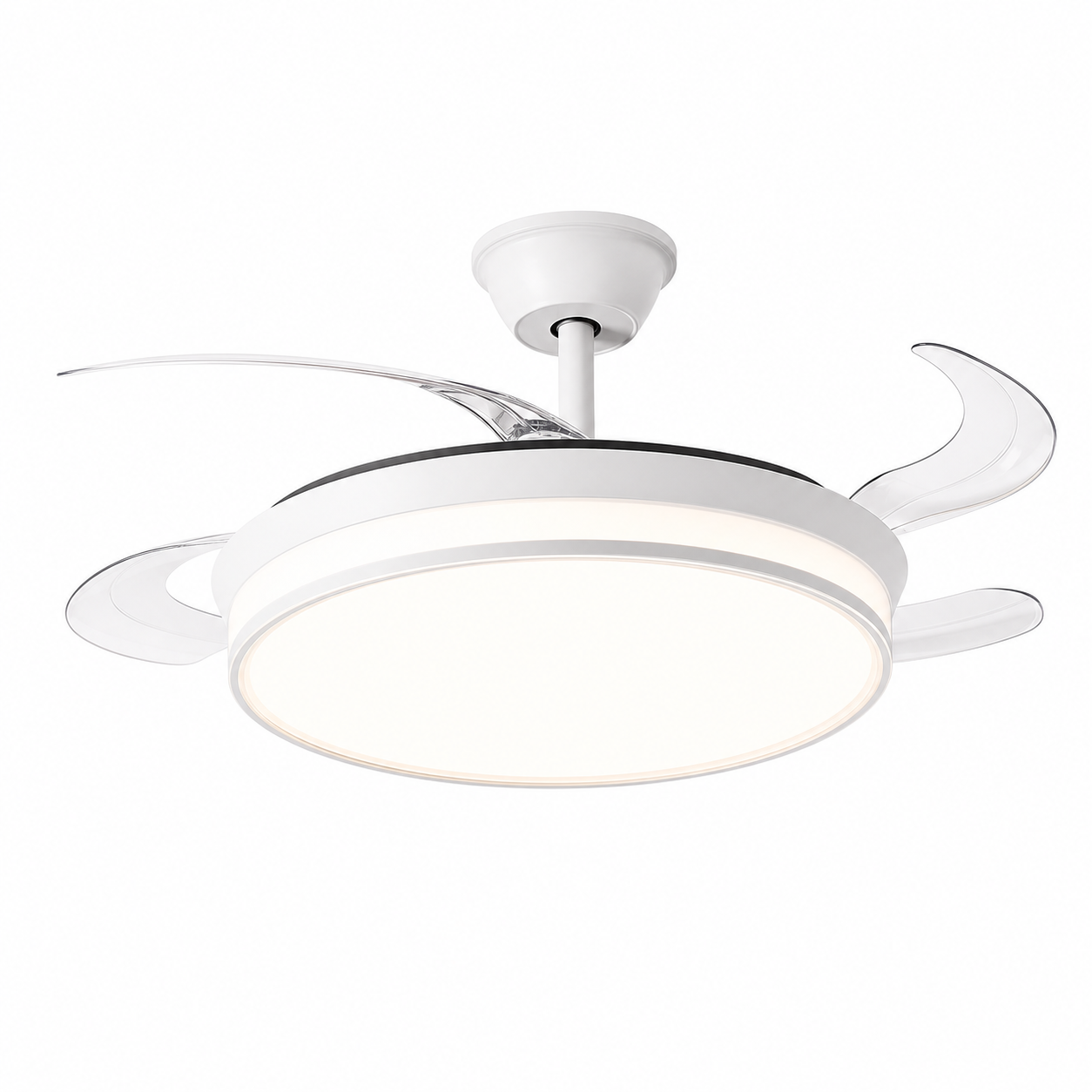


A ceiling fan is the one appliance in a flat that runs almost every day for ten years or more, so it is worth getting the size and the motor right the first time. This guide walks through the specifications that actually change how a fan feels in an HDB room: blade span, mounting height, motor type, the light kit and the controls.
Blade span vs room size
Blade span is the diameter of the circle the blades sweep, usually quoted in inches. A fan that is too small for the room has to run at top speed to be felt, which is noisy and wears the motor; a fan that is too large on a low ceiling feels gusty directly underneath it. Measure the room's length and width in metres and multiply them to get the floor area, then match it to a span.
- Under 10 m² (a common bedroom, a study): 36 to 42 inches. A 42-inch fan is the usual choice for a 3 m x 3 m bedroom.
- 10 to 18 m² (a master bedroom, a 4-room flat's dining area): 46 to 52 inches.
- Over 18 m² (a living and dining area in one open space): 56 inches or larger, or two smaller fans placed over the two zones. Two 46-inch fans usually cool an L-shaped living-dining room more evenly than one large fan in the middle.
Fans also publish an airflow figure, in cubic metres per minute (CMM) or cubic feet per minute (CFM). When two fans have the same span, the one with more airflow at the same power draw moves air more efficiently; it is a better guide to real cooling than the number of blades, which mostly affects the look.
Mounting height and ceiling clearance
Most HDB flats have a ceiling of roughly 2.6 m from the finished floor; older blocks and rooms with a false ceiling can be closer to 2.4 m. The usual guidance is that the blades should sit at least 2.1 m above the floor, and airflow is typically best when the blades are around 2.3 to 2.5 m from the floor with a few hundred millimetres of clearance to the ceiling above them. Follow the clearances in the maker's installation sheet over any rule of thumb.
Work out the fan's installed height from the specification sheet: the hanging height from ceiling to the bottom of the blades, plus any downrod. On a 2.6 m ceiling a fan with a short downrod of 150 to 200 mm lands in the right zone. On a 2.4 m ceiling choose a hugger (low-profile) model or the shortest downrod the maker allows, and avoid fans with a light kit that hangs below the blades.
Check where the fan will hang before you order. HDB flats built with a ceiling fan point have a hook or a junction box in the ceiling; if there is only a light point, the installer needs to run a cable and fix a new anchor. A fan must always be anchored to the concrete slab, never to the plasterboard of a false ceiling, so with a false ceiling the renovation contractor should leave a reinforced bracket or an access point at the fan position.
This is also the moment to confirm the model, because a fan that has already been installed cannot be returned unless it is faulty. Unused items in their original packaging can be returned within 15 days of delivery, so unpack and check the box contents before the installation date.
DC vs AC motors
An AC fan runs directly on mains power through a wall regulator or a pull cord and has three to five speeds. A DC fan has an electronic driver that converts mains power and controls the motor; it comes with a remote, usually has six speeds and reverse, and typically draws well under half the power of a similar AC fan at the same speed (compare the wattage on the two specification sheets). The difference on the bill is real but small for one fan; it adds up when three or four fans run through the night.
- Choose DC when the fan runs for long hours, when quiet operation matters (bedrooms) or when you want fine speed control and a timer from the remote.
- Choose AC when the budget is tight, when you prefer a wall regulator without a remote, or for a utility area where the fan runs on one speed.
- Reverse mode on a DC fan pushes air up in winter-mode; in Singapore it is mostly useful to circulate air-conditioned air without a draught on the bed.
With or without light
A fan with a light kit saves a ceiling point, which matters in a bedroom with a single central point. Look at the light's output in lumens, not watts: a fan light in the region of 1,500 to 2,000 lumens is typically enough for general light in a bedroom of 10 to 12 m², while a living room still needs its own ceiling or cove lighting and the fan light becomes a secondary source.
Most LED fan lights are three-colour: warm white around 3000 K, neutral around 4000 K and cool white around 6000 to 6500 K, switched from the remote. Some models dim in steps as well. If you want to switch the light and the fan separately from the wall, the fan point needs two live wires (a two-gang switch); with a single live wire the fan and light are both powered together and controlled from the remote, which is fine for most bedrooms.
Without a light the fan sits closer to the ceiling, has a cleaner profile and is a simpler product with less to go wrong. For a room that already has good ceiling lighting, that is usually the better choice.
Remote, wall control and smart options
DC fans ship with a radio-frequency remote that does not need line of sight. Keep the remote holder near the door or the bed, and check whether the fan can be paired with a second remote if the first is lost. A wall control module replaces the existing switch plate and gives speed and light buttons at the door, which is worth it in a living room where the remote tends to wander.
Smart fans add Wi-Fi or Bluetooth control through an app and voice assistants, with schedules and timers. They are convenient, but check that the basic remote or a wall switch still works when the Wi-Fi is down, and that the app does not need an account you would rather not create.
What to check before you buy
- Measure the room's length and width and work out the floor area in square metres.
- Note the ceiling height from finished floor to slab, and whether there is a false ceiling at the fan position.
- Find the existing fan hook or junction box and check it is where you want the fan to hang.
- Decide whether the fan needs a light, and if so whether the light and fan should switch separately.
- Count the speeds and features you will use: timer, reverse, dimming, a second remote or a wall control.
- Confirm reverse mode and the quoted airflow (CMM or CFM) if the fan will circulate air-conditioned rooms.
- Check the warranty years on the motor and on the electronics; they are often different.
Measured and decided? Shop Ceiling Fans


